
Trump urges Putin to halt aggression in Europe as US reaffirms military presence
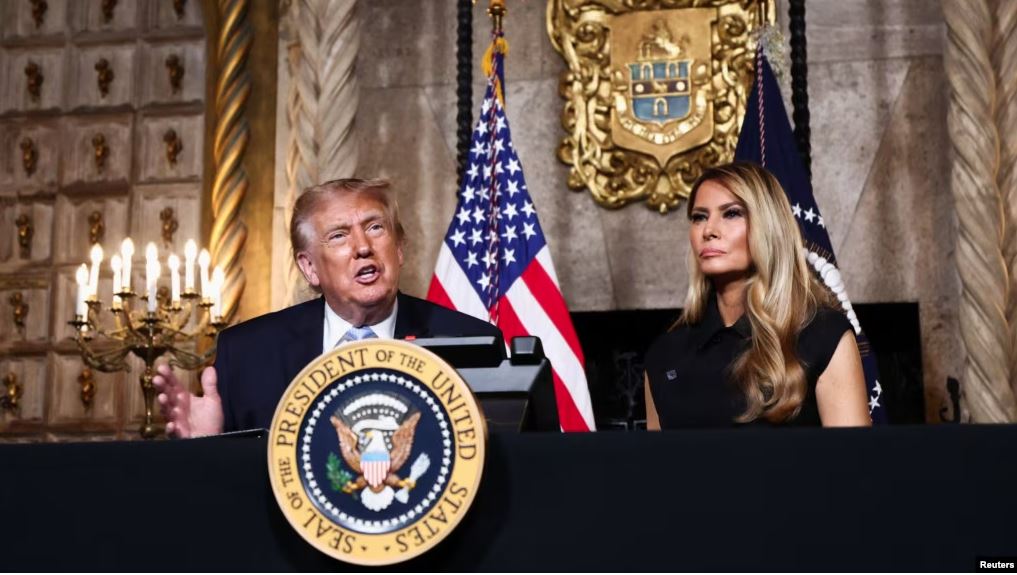
Trump urges Putin to withdraw from aggression in Europe as the US reviews its military presence
The US president, Donald Trump, has asked Russian President Vladimir Putin to halt all military aggression in Europe and pave the way for a peace agreement for Ukraine, while Washington pushes ahead with a review of its military presence on the continent.
In a post on the social media platform *Truth Social*, Trump wrote that during recent talks in China with Putin, he had asked the Russian leader to “withdraw from all military aggression against territories across Europe.” He emphasized that he “hopes a deal can be reached between Russia and Ukraine and that it happens soon.” Trump, in a post from November 26, described the conflict as a “bloodbath” that kills thousands of people every month.
In a later statement, Trump defended his shift in rhetoric toward Moscow, calling it a pragmatic negotiating tactic. He said, “I’ve been very tough on Russia, but I want to reach an agreement,” stressing that personal relationships are crucial in negotiations.
When asked about the reduction of around 80,000 US troops stationed in Europe (primarily in Germany, Italy, and the United Kingdom), Trump noted that European allies, following recent progress in increasing defense spending and purchasing new equipment, “make us feel a little differently.” He cited commitments from NATO allies to boost defense spending to five percent of GDP and the purchase of 750 F-35 fighter jets.
The US also has troops in Kosovo as part of NATO’s peacekeeping mission, KFOR. Washington has warned that changes will occur in its contribution to this mission, while in June, the US European Command confirmed it would gradually adjust its American contribution to KFOR in line with NATO’s plans.
US Deputy Ambassador to NATO, Scott Oudkirk, informed European diplomats during a closed-door meeting in Brussels that Washington would accelerate the publication of the review of the deployment of US forces in Europe beyond December 1.
The Pentagon is finalizing five distinct options, each with a formal military assessment, which will be presented to Trump. However, it is unclear whether a decision will be announced before the upcoming G20 summit in Florida, where Putin is expected to attend.
European allies under scrutiny
European allies are being assessed by Washington for their ability to replace American capabilities. US Deputy Secretary of Defense, Elbridge Colby, stated that he hopes to meet the December 1 deadline to deliver the final report to Defense Secretary Pete Hegseth. Colby praised Germany, Poland, the Netherlands, and Scandinavian countries for their progress in increasing defense spending.
However, political and operational pressures have complicated the review timeline. Political turmoil in the US, including the failed congressional effort to remove Hegseth, has caused delays. Operations against Iran and negotiations with Russia over Ukraine have further complicated Europe’s security architecture.
Expert analysis
James Batchik, deputy director of the Europe Center at the Atlantic Council, said that the delay does not change the US administration’s main objective: the structural transformation of Europe’s security. He noted that Trump’s unpredictable style forces Europe to remain vigilant, citing actions such as the withdrawal of an infantry brigade from Romania without replacement.
Tsiporah Fried, a senior fellow at the Hudson Institute, warned that the primary risk is the mismatch between the pace of US troop reductions and Europe’s ability to replace the corresponding capabilities. She stressed that US forces in Europe guarantee American involvement in the continent’s defense and strengthen the credibility of the US nuclear deterrent.
Fried cautioned that Russia is testing the alliance almost daily, mentioning recent violations of Polish airspace during Coalition exercises. She emphasized that NATO will evaluate allies not based on future spending commitments, but on the forces and capabilities they can deploy today.
The upcoming NATO foreign ministers’ meeting in Brussels, scheduled for next week, is expected to provide diplomats with a platform to discuss the review process, even without official proposals on the table.
In brief
Trump is urging Putin to withdraw from aggression in Europe, while the US reviews its military presence on the continent. European allies are being assessed for their capabilities, but political and operational pressures are complicating the process. Experts warn that reducing US troops could undermine Russia if Europe fails to replace the lost capabilities.




 Advertisement
