What’s happening in Kaliningrad and why could it spark a war between Moscow and Europe
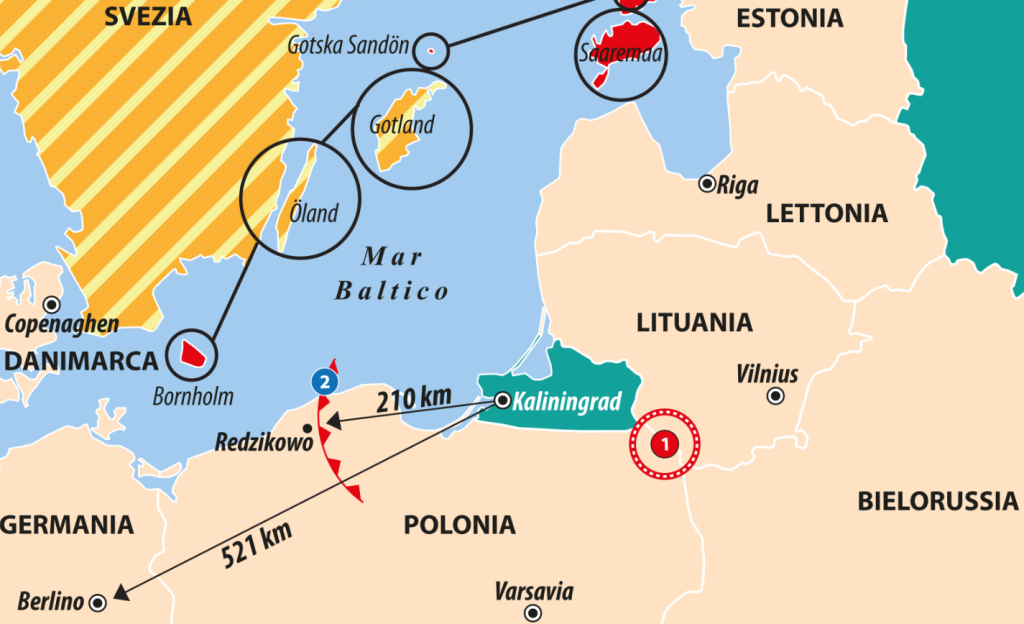
Before invading Ukraine, in more than twenty years in power, Vladimir Putin had threatened to use the atomic bomb three times. In the fifty-seven months of war, from 2022 to the present, he has done so 135 times. And the latest were to protect the Kaliningrad exclave: a chunk of the Russian Federation as large as Calabria and almost 500 km from the mainland. To understand its importance, one must read its geography, history and, above all, current events.
Sandwiched between two NATO countries
Kaliningrad lies on the Baltic Sea and is sandwiched between two NATO countries, Poland and Lithuania. It was once the capital of Prussia, known as Königsberg, and the birthplace of Immanuel Kant. Stalin seized it from Germany in 1945 after fierce fighting that led to the expulsion of 200,000 Germans, and after the Second World War he kept it thanks to the Potsdam Agreement between the Allied powers. At the time, its name was “Russified” in July 1946 in honour of Mikhail Ivanovich Kalinin, a member of the Soviet Politburo who had ordered the massacre of more than 21,000 Polish prisoners of war in the Katyn Forest.
With the fall of the USSR, collective farms were dismantled, the local economy collapsed and unemployment and drugs became social scourges. And to fight poverty, during the Yeltsin years it was decided to transform the exclave into a free port, with incentives for investors: the special status granted in 1996 revived the area, bringing industrial production growth, trade with the European Union and a new airport at a cost of 45 million dollars.
A fortified arsenal
Today, Kaliningrad is one of the places where peace in Europe risks being shattered. Nearly one million Russian-speaking residents live in the exclave, and Moscow’s leaders, from Dmitry Medvedev to Putin himself, have repeatedly hinted at armed intervention, as in Ukraine’s Donbas, to “save them from genocide perpetrated by Poles and Lithuanians.” A lie, because there has never been an uprising. In Warsaw, however, there is a government committee that has proposed “Polonising” the name of the Russian exclave to Królewiec: “A hostile act bordering on madness,” the Kremlin called it.
In reality, more than protecting an ethnic group, what matters is protection from missiles: in Soviet times, this was a highly militarised zone and even today it remains a fortified arsenal that gives Moscow the chance to have a fleet at the heart of Northern and Central Europe. Kaliningrad is Russia’s only Baltic port that never freezes. Yet, isolated as it is, its position makes it the most vulnerable point across the entire Federation. Under sanctions, it is impossible to reach it without crossing European territories, seas or skies. And in the event of war, a scenario by no means impossible, it would be difficult to supply it with troops and munitions. Near the town of Gvardeysk, the British newspaper The Times and the German broadcaster DW claim that Russia is building a giant OTH (Over-The-Horizon) radar that, starting from Kaliningrad, will have a surveillance range of 3,000 km and will allow interception of all satellite communications, every movement of aircraft and ballistic missiles, scanning every corner of Europe and Ukraine. “It’s a dangerous situation,” says Latvian military analyst Evija Dyatkovica, “because this technology puts NATO at a significant disadvantage. No one wants to give their adversaries an edge in the region. And now the exclave has become a strategic point on which a pre-emptive strike could be expected.”
Is anyone dying for Kaliningrad?
For years, NATO has denounced Russia’s “irresponsible nuclear rhetoric” around this zone. In 2013, in what was described as a response to US missile defence plans in Europe, Moscow deployed short-range ballistic Iskander missiles capable of carrying nuclear warheads. But since the start of the conflict in Ukraine, the Kaliningrad issue has resurfaced. Poland is the most alarmed: on 2 November it deployed additional military forces along the border and this year alone has accused Moscow 15 times of violating its airspace with drones and helicopters launched from Kaliningrad. Migrants are also a weapon, and as already happened with Belarus—where in recent years it diverted migration routes from Pakistan to Poland—civil flights from the Middle East to Kaliningrad have increased: along the 232 km border, to ward off possible “invasions” by migrants, the government in Warsaw has built a two-and-a-half-metre-high barbed-wire wall with motion sensors, cameras and anti-tank barriers.
Barriers along European borders
Episodes of hybrid warfare are countless. Estonia accuses Russia of being behind the arson attack in Tallinn last August on Milrem Robotics, a company that supplies NATO with drones to patrol Kaliningrad. The Estonians have long protected themselves on the Russian border with an 110 km barrier and in October began construction of 150 bunkers. Lithuania has also been granted permission to strengthen NATO’s defences: Germany has decided to increase its military presence in the Baltic country from 1,800 to 5,000 soldiers by 2027, including cyber warfare units. Lithuanian President Gitanas Nausėda has also announced the arrival of a new US contingent. The EU has funded a 30-million-euro fence on the Lithuanian border, two metres high and 130 km long, between Vištytis and the Neman River, which flows into the Baltic Sea. But the real critical point lies at the meeting of three borders: Poland, Lithuania and Belarus. This is the strategic Suwałki corridor, a 104 km strip of land with 70,000 inhabitants in Polish territory, which marks the border between Lithuania and Poland and links the Baltic states to the rest of NATO: if Russia were to attack, Suwałki would allow Kaliningrad to link up with Belarus, Moscow’s ally.
The shadow fleet sets sail from here
Mimicking the Baltic states, Finland has also closed its Russian border with a 200 km barrier. In January 2025, NATO launched Operation Baltic Sentinel: airborne patrols
of maritime systems, surveillance systems and hundreds of drones to protect data cables and gas pipelines in the Baltic Sea “damaged by Putin’s shadow fleet.” Since support for Russian operations abroad also exists in the seemingly harmless holds of commercial ships: specifically in Kaliningrad, at the port of Baltiysk, satellites photographed armoured vehicles and combat vehicles on board three merchant ships, Anastasiia, Lady D and Ascalon. The cargo, which according to the US government was destined for Russian contingents in Syria and Libya, was transported by the Russian maritime transport company MG-Flot, a shadow company already sanctioned among many firms that transport weapons and ammunition produced in Iran, including drones, across the Caspian Sea.
Calls for a response
Last May, Lithuania’s Foreign Minister Kęstutis Budrys asked NATO to “penetrate the small fortress of Kaliningrad” and destroy its missile bases. In mid-August, an anonymous NATO source told Reuters that an “unannounced” air exercise was under way around Kaliningrad: a test of the enclave’s ability to jam radar. Putin said it was merely “for defensive purposes, because none of our activities pose a threat.” At the same time, CIA Director John Ratcliffe made a secret 16,000-kilometre trip to Moscow to warn (among other things) that the United States would not tolerate any escalation in Kaliningrad or the Baltic states. “Putin knows perfectly well that he will never be able to defeat NATO,” NATO Secretary-General Mark Rutte clarified on 30 September.
The threat level has risen
The chill set in a month earlier, when Moscow responded to movements in Kaliningrad with the most serious threat of all: nuclear weapons. All these actions are “dangerous and irresponsible,” the Kremlin said. And if the enclave were touched, Russia would be ready to use “all the arsenal of forces and capabilities at its disposal, including nuclear weapons,” striking immediately at NATO’s “decision-making centres” in Brussels. “Europe is undoubtedly waging war against us,” Russian Foreign Minister Sergei Lavrov explained. For the Russian ambassador to Belgium, Denis Gonchar, there is a Western intention to isolate Kaliningrad: “An adventurous and irresponsible choice,” with “the risks of a direct armed conflict.” Former Russian ambassador to London, Andrey Kelin, is even clearer: “Anyone who supports plans to strike or blockade Kaliningrad will receive a response that includes nuclear weapons.” And Kremlin spokesman Dmitry Peskov added that Kaliningrad “is an integral part of the Russian Federation” and Moscow “will never allow anyone to violate its integrity.” On 16 October, it was the turn of Foreign Minister Maria Zakharova to call for a “devastating response, in the truest sense of the word, with all the means at Russia’s disposal. A war that will be very short.”
Five days after that statement, a Russian Su-30 fighter jet crashed in an uninhabited area of Kaliningrad. The pilots survived and the Defence Ministry said it was a training flight. For now, escalation is a matter of words and incidents. But in the silence of diplomacy, in this labyrinth of thorny borders and amid all this display of power, it is precisely in Kaliningrad that the perpetual peace dreamed of by Kant risks being extinguished. /Corriere della Sera/
The post What is happening in Kaliningrad and why could it spark a war between Moscow and Europe? appeared first on InfoShqip.com.
News source: infoshqip.com
Note: This material has been processed for informational purposes by the Portal Kosova.Today.