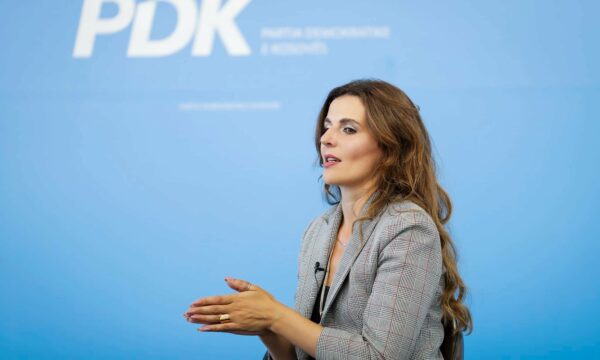
Justice Minister Jeton Shasivari: 'You can’t have both Soravia’s millions and Albanian! Either you can, but then you can’t!'

INA: Minister Shasivari, the debate over testing jurisprudence in Albanian is accompanied by political reactions. What is your comment?
Jeton Shasivari: I’ll start my response with a straightforward statement: *“You can’t have both Soravia’s millions and the Albanian language!”*
INA: What did you mean with this declaration?
Jeton Shasivari: This isn’t a matter of words, but of contrast and accountability. You can’t have both Soravia’s millions and the Albanian language! Or perhaps you can for a while, but then you can’t anymore—because it ends in opposition!
For more than two decades, patriotism has been sold to the public, but today we have the right to ask questions about the wealth, businesses, and financial ties of Ali Ahmet’s inner circle. At the same time, when it comes to a concrete right of Albanian citizens and students, political opposition emerges.
INA: Eight Albanian ministers of justice have led this institution since 2001. Do you consider this fact significant?
Jeton Shasivari: Absolutely, because history should help us understand accountability. Since 2001, eight Albanian ministers have headed the Ministry of Justice—eight ministers over more than two decades. And the question is simple: where were all these ministers during these years?
Where were they when entire generations of students faced this barrier? Why didn’t they resolve it when they had power, institutions, and all the political means at their disposal?
Why did it take 25 years for this issue to be addressed seriously and included in the agenda of concrete reforms?
The current government is the first since Macedonia’s independence in 1991—and the first to place this issue on the path to a concrete solution, with clear commitments to respecting and advancing linguistic rights.
For 25 years, they didn’t solve the problem. Today, they attack the solution!
This is the difference between demagoguery and accountability. Between those who create political noise and those who take responsibility to change things.
INA: Do you think today’s opposition is substantive or political?
Jeton Shasivari: When an issue remains unresolved for 25 years and political attacks begin the moment a concrete solution is proposed, citizens have the right to demand explanations.
I didn’t come to head the Ministry of Justice to manage inherited problems spanning over 20 years—I came to solve them.
We are not proposing privileges, lowering professional standards, or creating parallel exams. We are working toward a model that guarantees equal professional standards and fair opportunities for all candidates.
INA: Have you met with law students during this period? What have they told you?
Jeton Shasivari: I’ve met with hundreds of law students. I’ve explained and demonstrated the legal reform model to them. As a university law professor with 25 years of experience, I’ve encouraged every generation of students to overcome this language barrier.
What I want to emphasize is that these young people don’t seek privileges, favors, or exemptions. They don’t want lower standards. They simply want the right to prove their knowledge in the language that belongs to them.
I’ve met outstanding students who wake up early, work in call centers, some in markets, and others in construction. They work to pay for their studies, support their families, and build their future with their own efforts.
After a long day of work, they return to their books, study the law, prepare for exams, and fight for equal opportunity.
These are the students we should be talking about. These are the young people who deserve to be seen and heard in our society. The state should create opportunities for them—not leave them with obstacles.
This is exactly where the contrast lies that citizens have the right to highlight.
On one side, we have students counting every cent to buy bread and books, working in call centers, markets, and construction to finance their studies.
On the other side, we have public scrutiny over Soravia’s millions, a €5 million loan reported from Belgrade for a company linked to Ali Ahmet’s inner circle, and luxury cars worth €200,000 owned by his nephews.
I believe these contrasts cannot be ignored. Students who work diligently for a better future deserve the attention and support of institutions.
INA: What is your final message?
Jeton Shasivari: My message is very clear.
You can’t talk about patriotism only when it’s politically convenient. You can’t use the Albanian language as a slogan while doing nothing for over two decades to advance a concrete right.
And that’s why I repeat:
YOU CAN’T HAVE BOTH SORAVIA’S MILLIONS AND THE ALBANIAN LANGUAGE!
Or perhaps you can for a while, but then you can’t—because it ends in opposition.
Albanian is not anyone’s property. Justice is not a political privilege. And the rights of Albanians must not be hostage to anyone’s interests!
Source of the news: ina-online.net
Note: This material has been adapted for informational purposes by the portal Kosova.Today.